
Completing a Matzevah
Written 4 November, 2024

The card file at Yad Vashem reads:
Szekely, Dr
First name unknown
Satoraljaujhely, Hungary
List of murdered persons
There is a small plaque on a wall of a municipal building in the town of Satoraljaujhely, also known as Újhely in Hungary dedicated to the memory of my relative Dr Albert Avraham Szekely (Singer).
I hold a sheaf of old fading letters in my hand, they are from the mid 19th century and written in a combination of Yiddish and Hebrew. The letters were written by my ancestor Rabbi Isak Hirsch Singer to his youngest brother Rabbi Israel Singer.
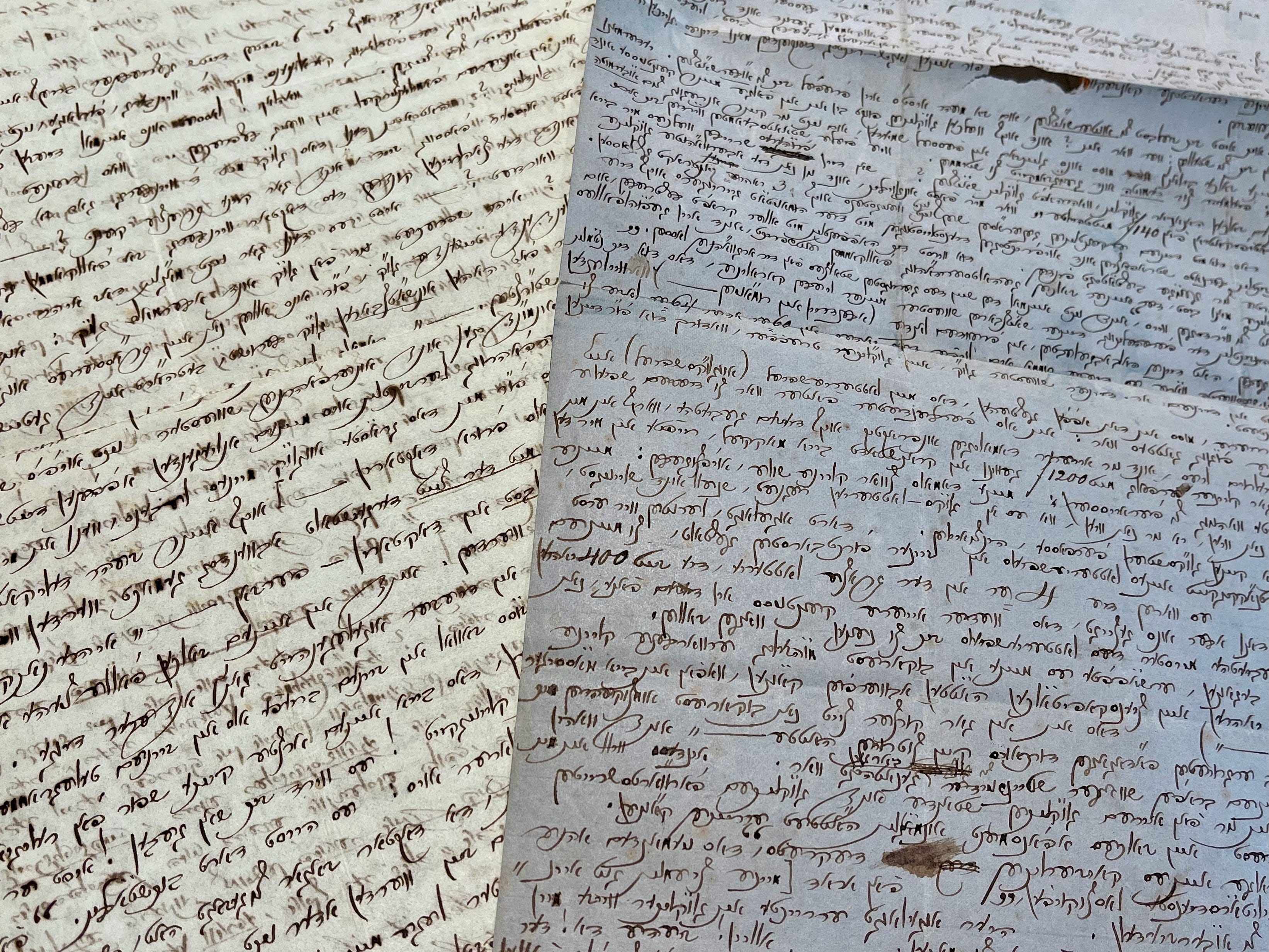
I hold another letter, dated 1923 and written in Hungarian from Dr Szekely to my great grandfather Dr Martin Singer explaining that he is returning these dozens of letters that might be of interest. Rabbi Isak Hirsch Singer was Martin Singer’s grandfather and Rabbi Israel Singer was Dr Szekely’s father.
In the letter Dr Szekely tells some family history, of when he was a young boy, he writes, Isak Hirsch was your grandfather, a great scholar with Hebrew writing and poetry in his beautiful Hebrew letters, and I saw his papers in my childhood and when my father read them, he was happy. He writes about when his father learned of Isak Hirsch Singer’s passing, how they sat Shiva and wept and studied Mishna. He tells of the murder of Rabbi Yehuda Leib Singer, another of the Singer brothers killed in the 1860’s by Muslim bandits on his return journey from Jerusalem.
In the letter Dr Szekely also talks of the fourth Singer brother, Rabbi Avraham Koppel Singer, a student of the Chatam Sofer and a staunch defender of Orthodoxy. He tells of his grandfather Rabbi Ascher Singer born in the town of Lelow in Silesia, the son of Rabbi Eizik, whose father was Rabbi Avraham, whose father was Rabbi Yitzchak of Lelow.
In 2022 my family donated most of our collection of family Rabbinic documents and letters to the National Library of Israel. They also included documents written by my ancestor the gaon Rabbi Daniel Prossnitz, Rosh Beis Din of Pressburg for 50 years; letters written by his dear friend and confidant the greatest of the Hungarian Rabbis the Chatam Sofer and letters and certificates written by his son the Ksav Sofer as well as many other Rabbis of the time, many of them were my relatives. Drashs and responsa, glosses, commentary and observations on Talmud, songs and prayers. A handwritten version of the controversial Sefer Toledot Yeshu probably penned by my ancestor Rabbi Meir Klein (Stroh) a student of the Chatam Sofer and a Magid Shiur of the Pressburg Yeshiva is included. The many documents provide an insight into the life and thoughts of a Rabbinic family and community of the time. These documents and stories are unique, not because they would have been particularly unusual documents at the time they were written; they are unique because against the odds they were brought to safety in Australia on the eve of WW2 where they survived to be seen and told and shared.
The State of Israel, the National Library of Israel, now the keepers of these embers. Yad Vashem is the keeper of tragic spiritual embers. The land and its institutions are holy places. They are not holy places because they are places of worship, they are holy places in the collective and individual memories they preserve, the truths that they hold and share, the profound recent and ancient history they protect, of an entire people. They bear witness to a long and complex story of Jewish existence. Perhaps sometimes with great sadness they honour the many dead who frequently perished at the hand of wicked injustice and violence but in doing so they serve to inform the living and the National Library is a living place filled with research, programs and activity. They are the keepers and protectors of our heritage that it should not ever be lost again as so much was lost.
Just like the synagogues and institutions of the great Jewish communities that were burnt to the ground at the hands of the Nazis or in pogroms before that, so too were the small communities like Lelow where nothing Jewish remained. Perhaps the few 18th century halachic deeds and letters of my family written in that town are some of the only surviving physical documents of that community.
I read the limited published histories of the town of Satoraljaujhely and its Jewish community and draw on some of that information here. The story of Dr Albert Avraham Szekely (Singer) mentioned above is not a typical one in the history of Jewish persecution and crimes committed against Jews. He was a lawyer and possibly the first Hungarian Jew to be appointed a Public Prosecutor. His father Rabbi Israel Singer received his semicha from Samson Raphael Hirsch after studying with other Torah greats including Rabbi Avraham Ullman and the Maharam Schik. Dr Albert Szekely and some of his brothers changed their surname from Singer to the Hungarian name - Szekely.
Towards the end of WW1, Hungary’s many domestic problems were accompanied by outbreaks of extreme antisemitism, especially evident in the daily press. Dr. Szekely published a public appeal in the town newspaper on July 6, 1918. He pointed out that the Hungarian press continually wrote about the positions being held by Jews instead of Christians; the gendarmerie for example ignored the constant thievery taking place in local factories but made all types of false charges against Jews. This, he wrote, in the fifth year of the war during which Hungarian Jews had made enormous sacrifices of life on behalf of Hungary. Thousands of Jewish families were mourning the loss of sons and fathers who had served. He added: “We must set up a self-defence league to protect Jewish honour by all legal means, to prosecute the press and to prefer charges against the agitators…This is the zero hour for self-defence. Every real Hungarian, every true Jew should stand up and be counted in defence of the Jews!” The proclamation was signed by Dr. Albert Szekely, Satoraljaujhely.
On July 16, 1918, on the pretext of looking for army deserters local police burst into the Sephard (Hasidic) beit midrash as the worshippers were deep in prayer, they assaulted the cantor and forcibly removed the tallit and tefillin from the congregants, shouting: “Identify yourselves!” Those who were of age to have served in the army produced their papers as did the older men who were already past the age for military service. Whoever tried to object was beaten. The entire congregation, including those who seventy years of age and more, were marched through the centre of town to the main square and from there to police headquarters as crowds of people lined the streets and jeered. The police picked up Jews in the street and broke into Jewish homes and yards. The police roundup and search did not uncover a single Jewish deserter from the Hungarian army.
In reaction, Dr. Szekely published another newspaper article headed: “What Happened in Újhely?” and described the attacks. Some of the local non-Jewish people sought to cover up their actions by claiming that they had not harmed anyone from the Status-quo Kehilla (modern Orthodox), only “those who wore a gabardine (Bekishe) and had side locks”. Dr. Szekely fumed as he asserted his solidarity with all Jews. He wrote; “A Jew, who is a scoundrel, should be put behind bars even if he is of elegant and gentlemanly appearance. But if an attack is with shameless impudence launched in a synagogue against an upstanding Jew who wears side locks, then whether it is the Orthodox or the Sephard, it becomes my synagogue, and I must be considered as one who has side locks and wears a gabardine, and I shall strike back at the attacker. Every true and upright Jew is my brother. I would prefer to give up my title as public prosecutor and to return all my medals, but I shall never be a traitor to my people”.
Dr Szekely was always an active and outspoken figure in public life and continued in many professional and honorary roles in the community both Jewish and non-Jewish. One of his brothers was a doctor who founded the new local hospital, another brother, Yissachar Dov (Bernard) Singer, a Rabbi who was Av Beis Din of the community Subotica which he led for decades.
The Germans invaded Hungary in March 1944 and a few days later reached Újhely. Orders to round up Jews happened soon after and a ghetto was established. Dr Albert Szekely was 80 years old, he and his wife Fani were rounded up and sent to the Újhely ghetto with thousands of other Jews of Zemplen county including many other descendants of Rabbi Israel Singer. Mrs Szekely died there, a few weeks later Dr Szekely was sent to Auschwitz where he was murdered by the Nazis. The campaign to murder Hungarian Jews was particularly ruthless and swift and achieved with a high level of complicity and assistance from the gentile Hungarian population. Over 500,000 Hungarian Jews were murdered in one year. None of Rabbi Israel Singer and his wife Katelin’s (nee Frankel) seven children in Zemplen nor their many descendants are thought to have survived the Holocaust.
I have read some bizarre and convoluted anti-Israel and anti-Jewish theories in recent years (especially since the events of October 7th, 2023) about how Jews weaponise the Holocaust and trauma or the notion that Jews fetishise their persecution. To observe historic injustices, crimes and persecutions, to mark them and fight against them today is not engaging in self-pity or weaponising the Holocaust. To understand and empathise with the trauma of these events is not weaponising trauma. These are now popular assertions amongst Israel’s critics, proposing that Israel justifies itself through a giant premeditated trick on the world of a colossal guilt trip. It is a scurrilous attempt to negate Jewish history and experience. Ignoring thousands of years of history, it is a ludicrous conspiracy theory with few equals.
The Jews of Újhely and the Jews of Hungary like many other communities in which Jews lived, did not start a war, they served their country loyally as do Jews across the world and throughout history where they have been allowed. Yet they were accused of disloyalty, a baseless accusation we are seeing again today even in Australia. It is others who weaponise Jewish suffering, trauma and the Holocaust, by weaponising the existence of Jews.
Israel is now at war and yet again forced to defend its very existence against the gravest of threats in a premeditated war thrust upon it. It is under direct attack on multiple fronts, notably from a major military power in Iran, a nation driven by committed fundamentalists who threaten to destroy Israel and if left unchecked they have the ability to do so. This is not a rehearsal for some other event and there is no reason to doubt their ambitions. Israel has no option but to win this war and press for peace. Sadly, the tempest of war brings trauma and suffering to so many. Peace must remain Israel’s ambition as it has always been for the Jewish people and as it ought to be for everyone. Israel’s enemies can keep lobbing missiles for the next 100 years. It seems like winning the war is Israel’s greatest challenge, but it’s not; resolving the conflict and living in peace is.
Today, as much as it might astound and disappoint us there are still those who should know better and who should be better; even in sophisticated and privileged polite western society, they are complicit in aiding the attempt to destroy the Jews both in Israel and in the diaspora, almost as it was all those decades ago in Hungary and Europe. The Jews and the nation State of the Jews are still surrounded by those who seek to erase our truth, our religion, our history, our future, and to vilify us at every opportunity.
Those old letters I held will soon join our other family documents in the collection at the National Library of Israel. I will update the incomplete card file at Yad Vashem, with both the first and Hebrew names of Dr Szekely and several other relatives. For eighty years we have been burying our dead, completing their inscriptions and searching for the names of the missing. In Israel today, they are also still writing inscriptions for the victims of evil and antisemitism, they are still burying the dead and searching for the missing. These names and their souls of blessed memory are not weapons, rather they are the horrific truth of the past and the jarring reality of these present times.
***
(If you would like to read more of my articles as they are published, please subscribe to my Substack)
Excellent account of your relatives and their incredible and powerful stories. Shining a light on these lost stories, and positioning it within our long history of antisemitism, gives us no solace in these times, but thanks for going to the effort of doing all this research and telling the story so eloquently.